¶ Drill 39: Wings and Deep
Skills focussed:
- DEFENSE: Zone Mid(6.2.2.4), Zone Deep (6.2.2.5)
- OFFENSE: Zone (5.4)
Concepts to know before doing the drill:
- Basic catching and throwing
- Rules of Ultimate
- Basics of zone cup
Drill Focus:
- Understanding the roles of the wings and the deep for preventing easy upfield and deep options.
Set-up:
- Players: 8. 3 Handlers, 2 Offensive Wings, 2 Defensive Wings, 1 Deep Defender
- Field: Use a realistic half-field setup.
- Rotation: Run for 20 passes, then rotate roles.
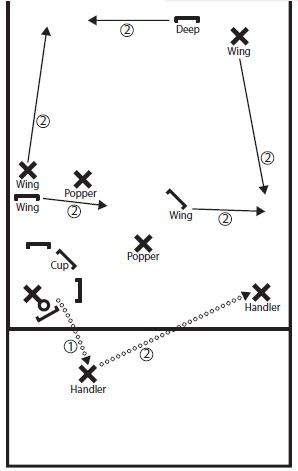
Drill-Flow:
- Roles:
- Offense: 2 offensive wings spread wide, keeping the field big. When the disc comes to their sideline → they cut in to receive a pass. When the disc is on the opposite sideline → they fall back and look for deep options.
- Defense: Deep Defender: Stays behind the deepest offensive player, preventing hucks. Two Defensive Wings: Guard the sideline regions.
- When the disc is on their side → they stay tight in front of any offensive player nearby. When the disc swings to the far side → they shift toward the middle to cover more space, but must be ready to recover.
- Flow:
- Handlers swing the disc back and forth, simulating real game movement.
- Offensive wings time their in-cuts when the disc is on their sideline and clear deep when it swings away. After a wing receives a pass, they should simply dump the disc back to the handlers and the drill proceeds as usual.
- Defensive wings mirror the offense: Stay tight when the disc is near.
- Shift centrally when the disc is far, maintaining readiness to recover.
- The deep defender positions behind all offensive threats at all times.
- After 20 passes, rotate players through all positions.
Coaching Points:
- Movement Awareness: Defensive wings must not be afraid to leave their sideline and shift towards the center when the disc is on the far side.
- Timing of Cuts: Offensive wings should cut and be free as the handler gains control on their side.
- Deep Safety: The deep defender must constantly check positioning to avoid being beaten.
Progression/Regression:
- Add a Static Popper: If you have an extra player, place a popper cone ~15m away. The far defensive wing must always be aware and in position to cover this option
- Game Application: Transition to a live scrimmage where players use the full zone, integrating wings and deep movements naturally.
Source: Page 147 UTM