¶ Drill 46: Poaching and Safe Throwing
Skills Focussed:
Other skills for which it can be used:
- CUTTING: In-cut (3.1), Deep-Cut (3.2)
- MARKING NON-THROWER: Person to person (4.2.2.1) & Body Defense (4.2.2.2) Cutter
Concepts to know before doing the drill:
- Basic catching and throwing skills
- Basic cutting and marking skills
- Basic rules of ultimate
Drill Focus:
- Handling poaches (open and hidden poach) effectively
- Train the thrower to recognize when a runner is truly open and only release the disc when the pass is safe.
Set-up:
This drill is done in 2 phases:
- Phase 1:
- Players: 4
- Roles: 1 thrower, 1 marker, 1 runner, 1 primary defender
- Cones: Two placed 10 m and 25 m from the thrower to mark the runner’s cutting zone.
- Phase 2:
- Players: 6
- Roles: 1 thrower and marker, 1 primary runner and defender, 1 stationary offensive player (like in a horizontal stack), 1 poaching defender (marking the stationary player)
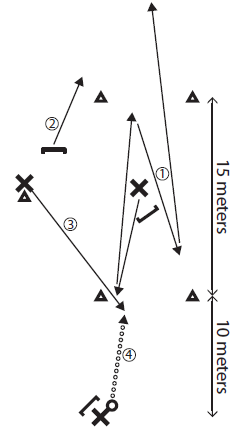
Drill Flow:
- Phase 1:
- The runner cuts back and forth between the two cones, attempting to get separation from the primary defender.
- The thrower observes and only throws when the runner is clearly open.
- If the defender closes the gap, the thrower must hold the disc—forcing the runner to continue cutting.
- No stall count.
- Rotate roles after each attempt.
- Phase 2:
- The runner cuts as in Phase 1.
- The poaching defender may leave his player to help on the runner.
- The thrower must decide: Throw to the runner if safe, OR Throw to the stationary offensive player when the poach leaves him open.
- If the stationary player’s defender leaves, the offensive player must cut immediately to exploit the poach.
Coaching Points:
- Phase 1:
- Throwers must prioritize safe passes, resisting the urge to force throws.
- Runners should maintain intensity, as persistence usually wins separation late in the cut
- Phase 2:
- Thrower: scan the entire field before throwing; use fakes to manipulate poachers.
- Stationary offensive player: cut decisively when poached on. Run for pass exactly at the moment when her defender leaves for poaching.
- Defense: Poach intelligently, not predictably.
- When a player notices that she's being poached on, she can also call out “poach!” This is a signal to the thrower saying two things: “Be careful. There might be a defender where you don’t expect it.” and “I’m open if you need me.” Next to this, calling “poach!” often also helps to stop the defender from poaching.
Source: Page 175 & 176 UTM