¶ Drill 37: Eyes in the back
Skills focussed:
- DEFENSE: Zone Mid (6.2.2.4)
Concepts to know before doing the drill:
- Basic catching and throwing
- Rules of Ultimate
- Basics of zone cup
Drill Focus:
- Developing the ability to track both the disc and offensive movement simultaneously, using peripheral vision and body positioning.
Set-up:
- Players per group: 3 (thrower, offensive runner, defender)
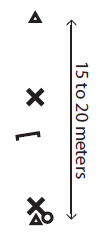
- Field: Two cones placed 15–20 meters apart.
- Positioning: Runner jogs between cones, turning at will.
- Defender stays 2–3 meters ahead of the runner, never more than 4–5 meters apart, and always faces the thrower.
- Thrower stands at one cone, holding a disc.
Drill Flow:
- Runner jogs slowly back and forth, making unpredictable turns.
- Defender stays in front of the runner while maintaining constant visual focus on the thrower.
- Defender uses small head swivels and peripheral vision to track the runner.
- The thrower may occasionally throw directly at the defender (waist height) to test readiness.
- Defender catches and returns the disc when thrown.
Coaching points:
- Body positioning: Defender should angle slightly (10–20°) toward the runner while primarily watching the thrower.
- Head swivels: Quick, minimal movements once per second; alternate shoulders to improve adaptability, try to look from the conrer of the eyes.
- Avoid overcommitting: Defender must maintain balance and not drift too far from the runner.
- Thrower’s role: Focus on testing the defender’s awareness, not completing passes to the runner.
Progression/Regression:
- Sideline Coaching Integration: Add a fourth player to act as a sideline coach, giving constant cues (“go,” “back,” “left,” “right”) to guide the defender. Encourage sideline coaches to use frequent communication with tone and urgency to convey intensity.
- Rectangle Variation: Replace the line with an 8-meter-wide rectangle, forcing defenders to move laterally and track both disc and runner with peripheral vision.
- Live Throw Threat: Once basic mechanics are mastered, allow the thrower to fake throws or occasionally throw to the runner to simulate real-game reactions.
Source: Page 145 UTM