¶ Drill 34: El Rondo
Skills Focussed:
Concepts to know before doing the drill:
- Basic catching and throwing
- Rules of Ultimate
- Low release throwing
- Catching high speed passes
Drill Focus:
- Setting up an effective cup (closing throwing lanes, forcing in a certain direction).
- Breaking through the cup as throwers (finding and exploiting gaps).
Set-up:
- Players: 7 (4 throwers, 3 defenders)
- Field: Use 4 cones to form a 10×10 m square.
- Positions: 1 thrower at each cone. 3 defenders form a cup around the active thrower. The remaining throwers stand at the other cones.
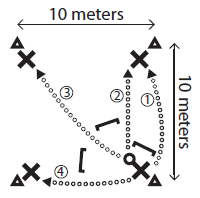
Drill-flow:
- Cup roles:
- Marker : job is to shut down the throw to one of the side players; forces the thrower toward the cup; prevents easy throws to the open side.
- Second Defender: covers inside break; should be covering enough space to have a shot at blocking the diagonal pass across the square
- Third Defender: helps block diagonals and prevents open-side passes.
- Execution:
- The disc moves around the square with only forehand and backhand throws.
- After each pass, throwers allow the cup to reset.
- Throwers should attempt to find and exploit holes with quick fakes and low, fast passes
- Rotation:
- When there’s a turnover, the player who caused it joins the cup.
- The defender who has been in the cup the longest rotates out.
Coaching points:
- Cup positioning is crucial. If there’s a gap, the throwers must exploit it immediately—this teaches the defenders where their structure failed.
- Defenders must stay low, balanced, and on toes for quick movements.
- Throwers should use fakes to widen small gaps before making passes.
- Watch for double teams—call it out when it happens, as in a real game.
Progression/Regression:
- Faster Cup Setup: Remove the rule allowing throwers to wait for the cup to reset. Forces defenders to set up quickly under pressure.
- Stationary vs. Moving Cup: Discuss with players whether the cup should remain set or move unpredictably. At lower levels, stationary cups can still block many passes. At higher levels, movement and unpredictability are key to disrupting accurate throwers.
- Larger Groups: For 8–9 players, use a pentagon or hexagon instead of a square.
- To balance the drill, prohibit throws to immediate neighbors on the open side.
Source: 139 &140 UTM