¶ Drill 44: Continuous Dump Play
Skills Focussed:
Other skills for which it can be used:
- MARKING: Person to person handler (4.2.1.1)
- MARKING: Thrower: Force (4.1.2), Pressure thrower (4.1.3)
Concepts to know before doing the drill:
- Basic Rules of Ultimate
- The Dump Procedure on open and closed side
Drill Focus:
- Sharpen dump resets, quick decision-making, and sideline escape strategies
Set-up:
- Players: 4 (Thrower A, Dump B, and their defenders).
- Layout: Sideline setup as shown in the figure (one player with disc, dump behind, defender on each).
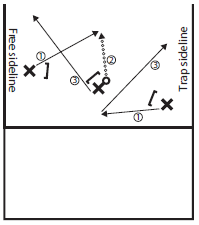
Drill-Flow:
- Dump B cuts up the line to receive a leading pass.
- Original thrower A sprints upfield to establish the new dump position.
- A then works to receive the disc again, either off the line or upfield.
- Repeat three times, then rotate roles.
Coaching Points:
- Immediate movement: Original thrower must start running as soon as he throws.
- Dump positioning: A should set up ~10m away from B, ensuring space for upfield cuts.
- Turn timing: Turn around only after passing the thrower by 3m—this minimizes lost yardage.
- Angles matter: Backward cuts should angle away from the thrower to allow a safe, floaty pass.
- Reading the defender: Always base final movement (turn, fake, or continue) on defender behavior.
- Key offensive options (based on defender reaction): Defender follows tightly → Turn back (run 4) and receive an off-the-line pass (pass 4). Defender is trailing → Continue upfield (run 5) to receive a pass gaining more meters (pass 5). Mixed defense → Use fakes: Start to turn, then continue upfield. Pretend to go upfield, then cut back for the reset. This quick decision-making keeps the defense off-balance and opens new throwing lanes.
Progression/Regression:
- Continuous Drill Mode: Offense aims to either: Gain 30m upfield, or Move disc 10m off the sideline. Defense’s goal is to prevent this. Drill continues until one condition is met or a turnover occurs.
Source: Page 161 & 162 UTM